
Ground improvement beneath new fill: understanding the supporting profile
The performance of a constructed platform depends on the ground profile supporting it. Where new controlled fill is placed over existing fill or natural soils, both the placed material and the ground beneath it influence how the finished platform responds to load.
This matters most where the underlying materials are variable or compressible. New fill can meet its compaction specification while the ground below it is still able to deform. The interaction between the fill and its support sits at the centre of ground improvement planning.
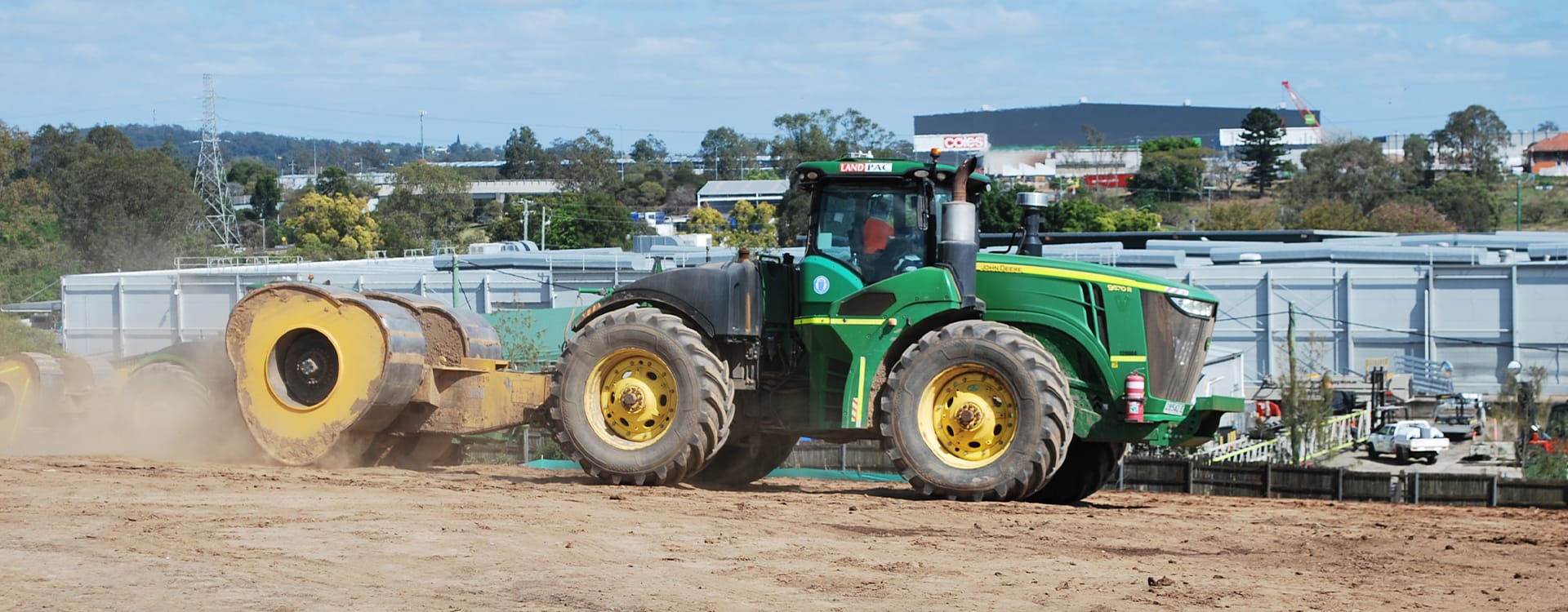
At Landpac, these considerations shape how we assess where High Energy Impact Compaction (HEIC) can contribute to a project. They influence treatment selection, construction sequencing and how we interpret ground response during the works.
How underlying ground influences platform performance
Placing new fill loads the existing ground before the development is in service. The underlying materials have to carry the weight of that fill, then the structural, traffic or operational loads that follow. Where compressible deposits are present, settlement can develop within them even when the fill above has been built to specification.
How that settlement is distributed matters as much as how much there is. Changes in the thickness, compressibility and engineering properties of the underlying deposits can produce differential settlement across a platform. Variation in subgrade compressibility needs particular attention, because differential movement affects serviceability, can speed up deterioration and can cut short the platform’s design life. Deformation within compressible subgrades, for example, contributes to surface depressions and deterioration in pavements.
A well-compacted upper layer therefore has to be considered as part of its supporting profile. When investigating potential movement, the project team needs to establish where deformation is expected and how it could affect the finished platform. Deficiencies in the placed fill and compression of underlying deposits can call for different responses.
Defining the ground improvement objective
An effective treatment strategy starts by identifying the material and mechanism behind the engineering concern. Loose granular fill, heterogeneous historical fill and deep compressible cohesive deposits can all present a settlement risk, but they behave differently and respond differently to treatment.
In suitable loose granular materials, improvement comes from particle rearrangement and a reduction in void space. A deep saturated cohesive deposit may instead need consideration of consolidation, drainage and the time over which deformation occurs. Both can produce settlement. That doesn’t make them the same treatment problem.
The proposed loading and allowable deformation then need to be considered alongside the ground conditions to establish which parts of the profile control performance and what improvement is required. Treatment selection should address the identified material and deformation mechanism, with the proposed method assessed against those conditions.
When assessing HEIC, we need to establish whether the identified materials can respond beneficially within the proposed treatment arrangement. Weak ground on its own doesn’t decide suitability. Deep soft deposits may require another method, while suitable existing materials with variable compaction or localised differences in response may be a good opportunity for impact treatment.
Considering treatment alongside fill placement
Where a project includes new fill, the treatment sequence should be worked out before the earthworks approach is fixed. The working level HEIC is applied from, the thickness of material above the intended treatment zone and the properties of that material all bear on the assessment.
Treating exposed existing ground and treating from the surface of placed fill are different arrangements. Once fill is in place, the impact is applied to that material and transferred through it to the supporting ground. An improvement observed in the upper material can’t automatically be attributed to the ground beneath it.
How much of the impact energy reaches the ground below depends largely on the fill itself. HEIC influence typically extends 1 to 5 m depending on soil type, moisture, groundwater and the module used, with the greatest improvement in the upper 2 to 3 m, so every metre of fill above the target zone reduces the effort available at depth. A stiff, well-compacted fill layer spreads the impact load over a wider area, while softer or wetter fill absorbs more of the energy within the layer itself. Moisture matters in both layers. Very wet cohesive material can build pore pressure under repeated impact instead of densifying, which limits the zone of influence. The working level sets the starting point for all of this, so treating existing ground before it’s covered, or lowering the working level, can put more of the effort where it’s needed.
Landpac uses HEIC to improve suitable existing material in situ, with impacts at the surface able to influence ground below the immediate working level. The extent of improvement still has to be established for each project, taking account of the materials and treatment conditions. Results from other sites provide experience and context, but they don’t demonstrate the outcome at a new one.
Planning treatment and fill placement together lets the project team build assessment stages into the construction program. Assessing existing ground before it’s covered gives a reference condition for interpreting later observations and test results, and allows any localised treatment to be incorporated into the works.
Interpreting response within a layered profile
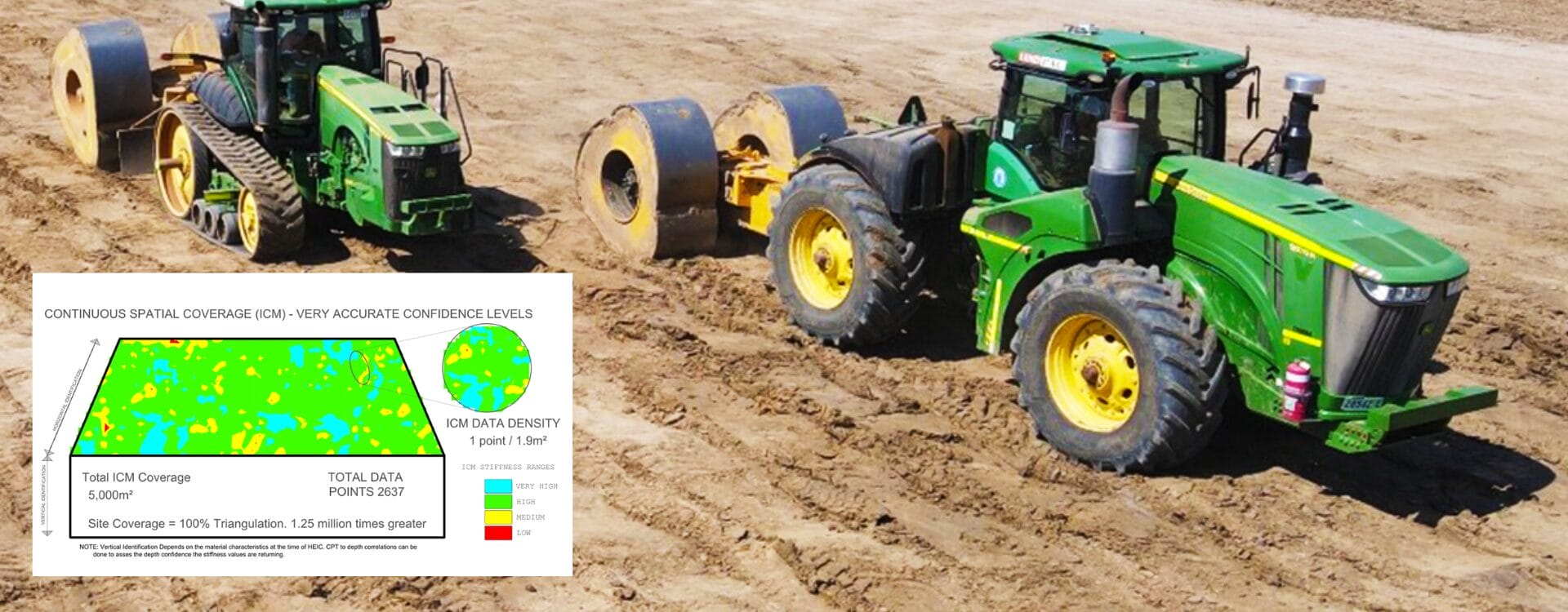
Intelligent Compaction Measurement (ICM) provides a spatial record of machine and ground response during HEIC. In layered ground, the recorded response reflects the combined influence of near-surface material and the conditions beneath it, so knowing the profile is essential to interpreting it.
A change in response during treatment can come from changes in the placed material, variation in its support or interaction across the profile. The measurement doesn’t separate the contribution of each layer. As covered in Landpac’s article on calibration, correlation and ground response, interpretation requires the response data to be read alongside representative testing and known site conditions.
Research into intelligent compaction with vibratory rollers also identifies underlying support conditions as an influence on measurement values. Those systems differ from HEIC, but the principle carries over: a measurement generated by loading at the surface can be influenced by material beneath the layer being worked.
The value of ICM here is in seeing how response varies across the treatment area and how it changes as work progresses. Establishing what those changes mean for the underlying ground needs supporting evidence chosen to address the intended improvement.
Aligning verification with the treatment zone
Verification should assess the ground and behaviour identified in the treatment objective. Where improvement beneath new fill is required, the evidence has to extend to the relevant underlying material. Results confined to the placed layer can’t establish an outcome beyond their own measurement or influence depth.
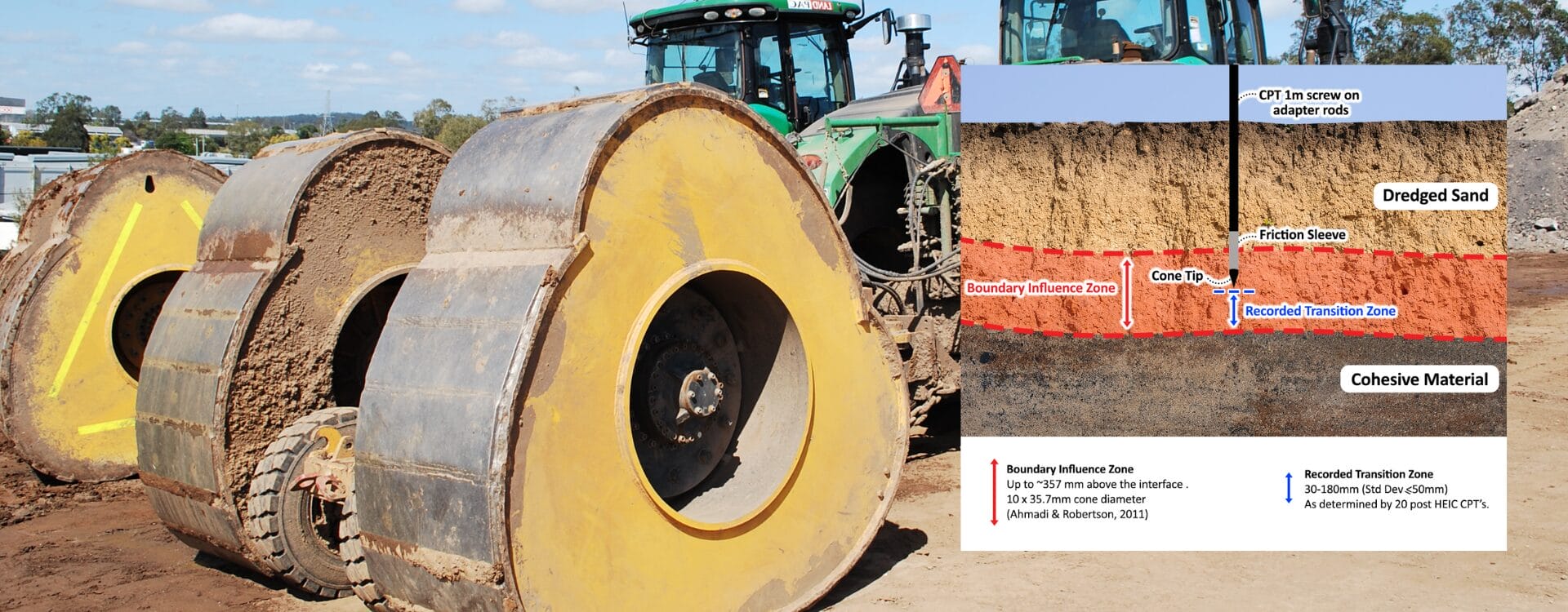
This distinction also matters when comparing monitoring data with discrete test results. Different measurement footprints and influence depths mean roller measurements and conventional spot tests can reflect different combinations of material properties. Where a material boundary falls within the assessed profile, an apparent difference between results may simply mean the methods are responding to different volumes of ground.
The investigation and verification scope should therefore be built around the questions the project needs answered. Investigation objectives and the selection of appropriate techniques should establish the ground profile, the location of potentially deformable materials and the conditions relevant to treatment. That understanding is the basis for choosing verification locations and depths that address the expected behaviour.
Within a HEIC program, ICM provides the full-coverage record of treatment response, while representative in-situ testing provides evidence at selected locations and depths. Read together, the two datasets let the project team check whether observed changes are consistent with the required improvement and where further investigation is warranted.
Ground improvement across in-situ, cut and fill areas at Goodna
At a residential subdivision in Goodna, Queensland, Landpac’s HEIC program covered treatment of existing ground followed by fill placement. In-situ subgrades and cut areas were treated before filling, then fill was placed and compacted in nominal one-metre lifts using three- and five-sided impact modules.
Real-time ICM monitoring ran throughout, recording settlement, relative ground response and pass coverage. In Area 6, the ICM stiffness maps alone picked up a soft zone after six surface passes. The existing fill there contained deleterious material, including construction waste, along with very wet cohesive material, and this had compromised the zone of influence.
Because the problem showed up early, the material was investigated and removed before the full compaction cycle was completed, rather than putting more compaction effort into ground that couldn’t respond to it. That early detection allowed immediate remediation and delivered a uniform platform for the intended use. It shows how monitoring can inform construction decisions where the condition of existing ground still matters to the fill being placed above it.
Assessing performance through the ground profile
The condition of the underlying ground matters throughout construction and into service. Where new fill is introduced, confidence in the finished platform depends on understanding how the placed material and its support will carry the proposed loading.
A sound ground improvement strategy connects that understanding to the treatment method, construction sequence and verification program. For HEIC, that means establishing where impact treatment can achieve a useful outcome and gathering evidence that addresses the relevant materials and depths. The result should be a defensible explanation of how the improved ground profile supports the intended use of the platform.
If your project involves placing new fill over existing ground, talk to Landpac about your ground improvement requirements. Our team can review the available geotechnical information, proposed fill arrangement and performance requirements to assess where HEIC can contribute to the works.
Latest news
Ground improvement beneath new fill: understanding the supporting profile
The performance of a constructed platform depends on the ground profile supporting it. Where new controlled fill is placed over existing fill or natural soils, both the placed material and the ground beneath it influence how the finished platform responds to load.
Interpreting qc Response Near Sand-to-Clay Interfaces
Why lower qc values near sand-to-clay interfaces do not always indicate weaker ground conditions.
High-Energy Impact Compaction: Calibration, Correlation and Ground Response
HEIC does not measure modulus or bearing capacity directly. It measures how the ground responds to impact. This article explains how calibration and correlation transform that response into meaningful, site-specific engineering insight.
