
High-Energy Impact Compaction: Calibration, Correlation and Ground Response
In ground improvement, the objective is not simply to densify soil. It is to produce a platform that will perform under load with sufficient uniformity, stiffness and confidence for its intended use. That distinction matters. As discussed in our earlier article on why modulus matters, density alone does not directly describe how the ground will behave under working load. Calibration is what helps connect HEIC stiffness response data to those more meaningful performance-based parameters.
High-Energy Impact Compaction (HEIC) can deliver significant energy through the ground profile, improving material well beyond the immediate surface. When paired with Intelligent Compaction Measurement (ICM), it provides a continuous record of how the ground is responding to each impact event across the treated area. An added benefit of this approach is the ability to extend Intelligent Compaction deeper into the profile, capturing response from layers that traditional equipment cannot effectively influence. That response data is powerful, but only when it is interpreted correctly.
A HEIC system does not directly measure bearing capacity or modulus in the same way a design report might present those parameters. What it measures is machine response during impact, typically in the form of drum deceleration and associated impact behaviour. To convert that response into meaningful engineering interpretation, the data must be correlated against representative in-situ testing and calibrated to the site conditions. That is where the science sits.
However, HEIC does not directly measure design parameters such as bearing capacity or modulus. Instead, it records machine response during impact and typically drum deceleration and associated impact behaviour. To translate this response into meaningful engineering parameters, the data must be correlated with representative in-situ testing and calibrated to the specific site conditions. That is where the engineering science resides.
What HEIC measures
At a high level, HEIC is not measuring “compaction” as a property; it’s rather a proxy for soil behaviour. HEIC, on the other hand, measures system response to dynamic loading and essentially how the ground reacts when subjected to high-energy impacts. It measures the system response of the machine–ground interaction during impact. More specifically, each drop event produces a transient response governed by contact stiffness at the drum–ground interface, energy transfer and loss through the soil mass, damping behaviour (material and geometric), and local heterogeneity such as inclusions, layering and moisture variation. Within an ICM-enabled setup, this is captured as a time-based deceleration signal, spatially tagged across the site. What is recorded is not just a magnitude, but a response signature that reflects how energy is being absorbed, reflected and dissipated through the profile.
Two points are worth making here. First, the signal is system dependent. It reflects both ground behaviour and machine characteristics such as mass, drop height and contact geometry. That is why absolute interpretation without calibration is inherently limited. Second, the response is sensitive to near-surface and underlying conditions simultaneously. A stiff crust over softer material, a buried rock, or a transition in material type can all produce similar peak responses for different reasons. The signal itself does not distinguish cause. It reflects the outcome.
This is why treating ICM output as a direct proxy for modulus or bearing capacity is technically weak. What HEIC provides is a high-resolution, spatially continuous response field. It shows how the ground is reacting under repeated dynamic loading, where that reaction is consistent, and where it is not. That is the value. It is not a direct modulus map in isolation, but a relative stiffness that can be correlated for additional confidence. It is a response map that becomes engineering-relevant only when tied back to calibrated, representative ground truth. Even if not used to correlate with in-situ testing, the relative stiffness map alone will exhibit low, medium, high and very high stiffness zones that can be targeted for immediate remediation purposes and/or in-situ testing verification purposes.
Measured response versus inferred performance
This is one of the most important distinctions in HEIC verification. Drum deceleration is measured. Ground performance parameters are inferred. Those inferred parameters may include relative stiffness, likely deformation behaviour under load, improvement trends with additional passes, areas requiring further treatment or investigation, and potential alignment with target modulus or support criteria.
Without calibration, the response data still has value as a diagnostic and quality-control tool. It can show consistency, variability and changing behaviour during treatment. But if the goal is to link the response to design-facing parameters such as modulus, support capacity or expected performance, then a site-specific calibration process is required. This is not a limitation of HEIC. It is simply sound engineering practice.
Why calibration matters
Calibration is not an optional refinement step in HEIC verification. It is a requirement because HEIC was not designed as a verification tool. Roller-based measurement systems do not produce an industry-standardised engineering parameter. They produce a response signal influenced by both machine characteristics and ground conditions. As a result, interpretation without correlation to representative in-situ testing is inherently limited. This is well established in intelligent compaction research and practice. Measurement values derived from roller systems are considered indicative of in-situ stiffness, but not directly equivalent to design parameters unless they are calibrated against site-specific testing, as outlined in the FHWA Intelligent Compaction guidance.
Ground response under dynamic impact is influenced by more than one variable. Material type, moisture condition, layer thickness, particle breakage, density state, confinement and the presence of hard inclusions or buried anomalies can all influence the measured signal. The same measured response value may not mean the same thing from one site to another, or even from one material zone to another within the same site. For that reason, correlation should not be approached as a universal equation applied blindly across projects. It should be built from specific sites and representative tests, informed by the geotechnical model, and reviewed against what is physically known about the site.
Where calibration is done well, HEIC mapping becomes substantially more useful. It moves beyond a relative heat map and becomes a basis for understanding how ground response aligns with actual platform performance.
What calibration is doing
Calibration is often described as “correlation”, but the two are not the same. Correlation is the mathematical output, typically a regression relationship between measured response and known engineering parameters. Calibration, however, is the multi-stage engineering process that underpins it. The measured signal is a response to impact, not a design parameter, and calibration establishes whether that response can be reliably related to properties such as stiffness or deformation behaviour. This is the step that allows a response map to be interpreted in the context of modulus-based design thinking, rather than remaining purely observational.
The response signal is influenced by machine-specific factors such as speed, turning, mass, drop height and contact geometry. Calibration helps account for these effects so that the interpretation reflects ground behaviour, not just machine behaviour. This is one of the reasons a universal “number” for HEIC response does not exist across different equipment platforms or even the same machines for that matter.
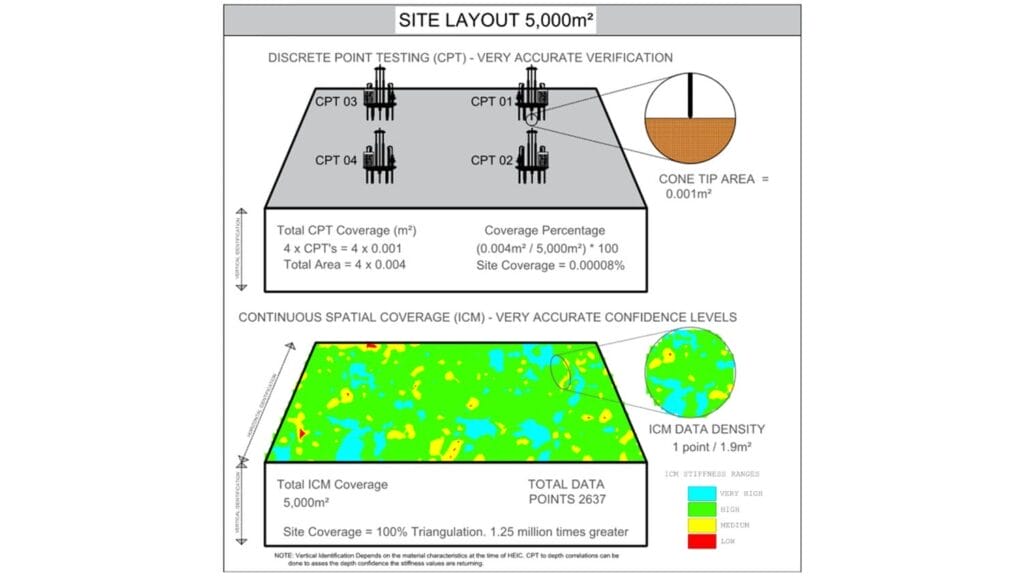
ICM provides continuous spatial coverage. In-situ tests provide discrete but physically grounded measurements. Calibration connects the two. Representative test points anchor the response field, allowing engineers to interpret variability across the site with reference to known, measured conditions rather than assumptions between test locations.
Without calibration, high or low response values can be misinterpreted. A stiff response may reflect a competent layer, or it may reflect a localised inclusion. A lower response may indicate weaker material, or simply a change in confinement or moisture. Calibration reduces that ambiguity by tying response behaviour back to verified material conditions. In practical terms, it shifts HEIC from a qualitative indicator to a calibrated, decision-support tool.
What calibration can and cannot tell you
What calibration can tell you includes how measured HEIC response relates to site-specific stiffness or deformation behaviour when anchored to representative testing, whether variability across the treatment area sits within an acceptable range for the intended performance, and where further treatment, investigation or correlations are warranted based on calibrated response trends.
What calibration cannot tell you includes that it does not create a universal modulus value transferable between sites or machines, it does not remove the need for sound geotechnical judgement or an understanding of site conditions, and it cannot fully resolve ambiguity where ground conditions are highly heterogeneous without adequate test coverage.
Sound correlations improve interpretation. It does not replace engineering.
A practical calibration framework
No single in-situ test defines ground performance in isolation. A robust calibration approach is typically built from multiple methods, each contributing a different perspective on ground behaviour. In practice, this means combining methods to understand both surface response and behaviour through the profile, rather than relying on any single test result in isolation.
Heavy Weight Deflectometer (HWD) is often one of the most useful calibration tools for HEIC because it applies an impulse load and measures the resulting deflection basin, making it particularly relevant for understanding dynamic modulus response (rapid impulse, strain-rate effects) Plate Load Testing (PLT) remains very useful as a widely recognised method that provides static load response, but must be interpreted carefully, given the difference between static and dynamic behaviour. Cone Penetration Testing (CPT) provides continuous information with depth, making it critical for understanding soil resistance through the profile at depth rather than just at the surface. Other supplementary methods, such as DCP, proof rolling, settlement monitoring and geophysical testing, can support interpretation with a well-supported calibration strategy.
Why full-area response mapping changes the conversation
Traditional verification often requires full-time geotechnical supervision, which relies on point testing as per site frequency, which is often NDT’s and the likes that rely on required MDD’s and lab results, as well as strict moisture and particle size specifications. That approach becomes less reliable where uncontrolled fill, rehandled material or variable ground conditions are present.
This is where Intelligent Compaction Measurement (ICM) materially changes the quality-control process. By recording response continuously across the treated area, variability becomes visible rather than assumed. Stronger and weaker zones can be identified, test locations can be selected more intelligently, and confidence between isolated test points improves. The objective is not to eliminate in-situ testing, but to make it more meaningful by placing it within a broader response framework. ICM aids the geotechnical sign-off engineer with a higher level of confidence in what is being achieved between the in-situ verification test points.
Calibration as a risk-management tool
Poor verification does not always fail immediately. The consequences often appear later as settlement, stiffness variation, differential movement or rework. Calibration helps reduce that risk. When HEIC response is correlated with representative field testing, engineers can make better-informed decisions about whether treatment has achieved the intended improvement, whether variability remains acceptable, where further treatment is required, and how well the platform aligns with performance expectations. This is particularly important on variable sites such as uncontrolled fill, where a few isolated test results may not represent overall conditions.
The engineering value of correlation
Correlation should not be viewed as a process of making one dataset resemble another. Its role is to connect machine-measured response to material behaviour in a way that is technically defensible and relevant to the project. Done properly, it allows teams to move from isolated results to spatial understanding, from relative response to calibrated interpretation, and from compliance-based compaction to performance-oriented verification. This is where HEIC becomes more than a treatment method and instead becomes part of a broader diagnostic and control process.
Conclusion
HEIC produces more than compaction energy, it is an onerous proof roll that measures relative dynamic stiffness across a site. It produces real time response data that can be viewed by an engineer on site or remotely via a smart phone or computer. The value of that data lies in calibration. While drum deceleration shows how the ground responds across the treatment area, it does not replace geotechnical testing. Its value is realised when it is correlated with representative in-situ methods such as HWD, PLT and CPT and interpreted within the context of site conditions and performance requirements. When that framework is in place, HEIC with ICM provides calibrated visibility of ground response at scale, supporting confidence for more reliable geotechnical verification, better decision-making and improved long-term performance.
Latest news
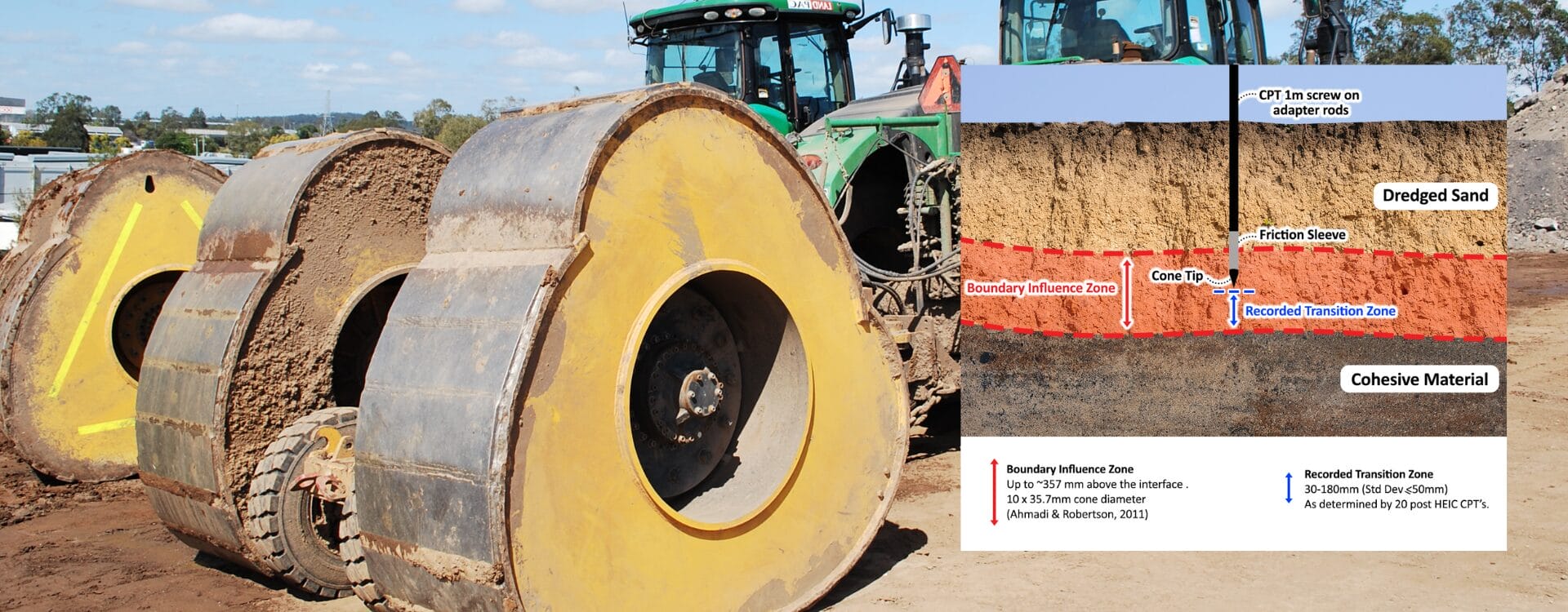
Interpreting qc Response Near Sand-to-Clay Interfaces
Why lower qc values near sand-to-clay interfaces do not always indicate weaker ground conditions.
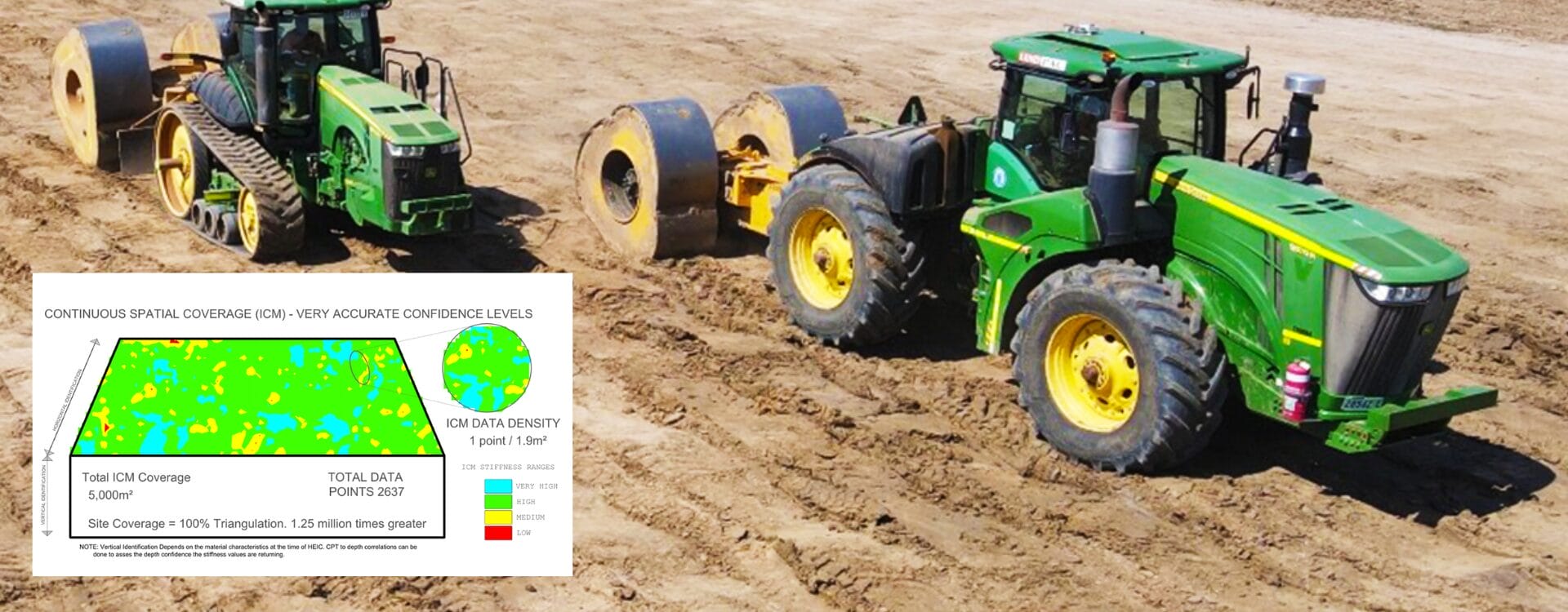
High-Energy Impact Compaction: Calibration, Correlation and Ground Response
HEIC does not measure modulus or bearing capacity directly. It measures how the ground responds to impact. This article explains how calibration and correlation transform that response into meaningful, site-specific engineering insight.
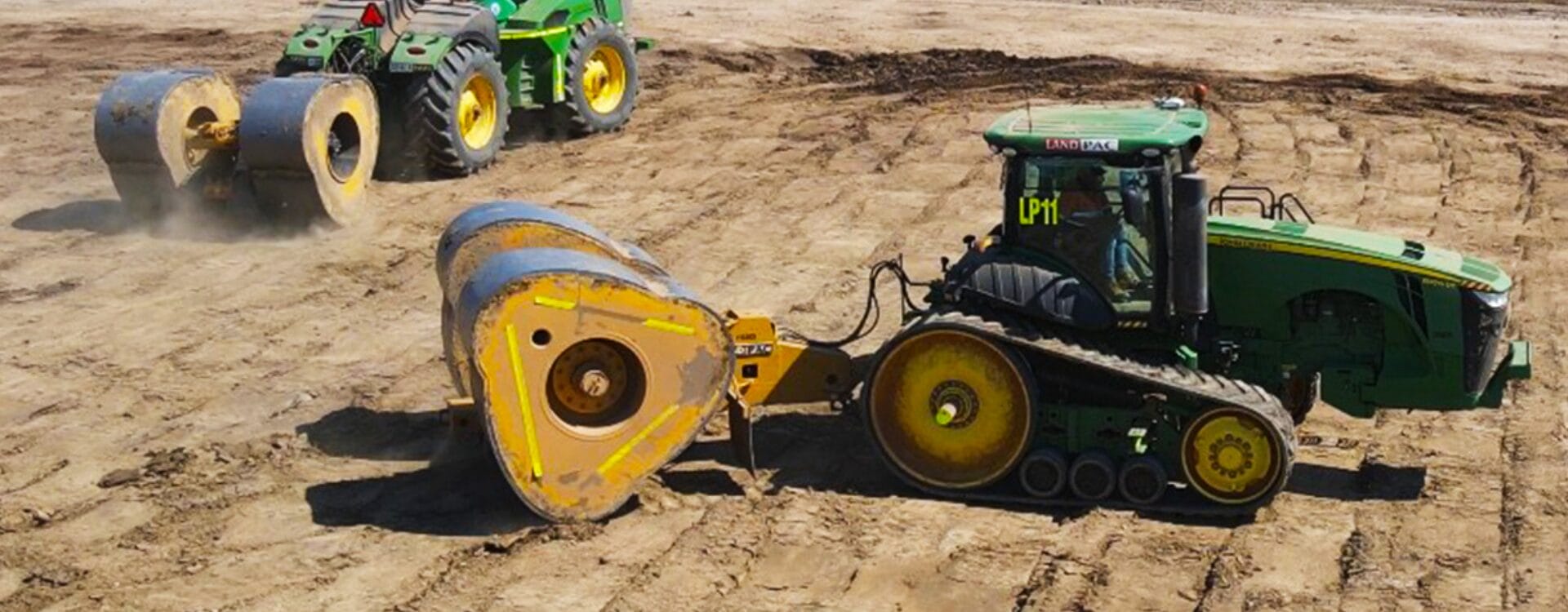
Why Modulus Matters: Moving Beyond Density in Ground Improvement
Density has long guided compaction, but it does not reflect how ground performs under load. This article explores the shift to modulus-based verification using HEIC, ICM and in-situ testing.
