
Interpreting qc Response Near Sand-to-Clay Interfaces
Lower cone resistance (qc) values near sand-to-clay interfaces in Cone Penetration Testing (CPT) are often interpreted as evidence of weaker ground or isolated under-compaction. In layered soil profiles, however, transitional CPT behaviour can occur as a function of stiffness contrast and probe geometry rather than an actual change in compaction quality.
This becomes particularly relevant where dredged sand fill overlies softer cohesive materials, creating strong stiffness contrasts within the CPT profile.
In these situations, the cone can begin responding to the softer underlying layer before the tip physically reaches the interface itself. Without understanding this behaviour, normal boundary influence effects can easily be interpreted as anomalous CPT results, inconsistent ground response or localised weaker zones within the profile.
The challenge is that CPT data is often reviewed numerically first and mechanically second. In layered systems, however, the mechanics of the interface itself can significantly influence the measured response.
Understanding Boundary Influence
Cone Penetration Testing (CPT) measures the response of soils as the cone advances through the ground. In uniform materials, interpretation is generally straightforward. At material interfaces, however, the measured response becomes more complex.
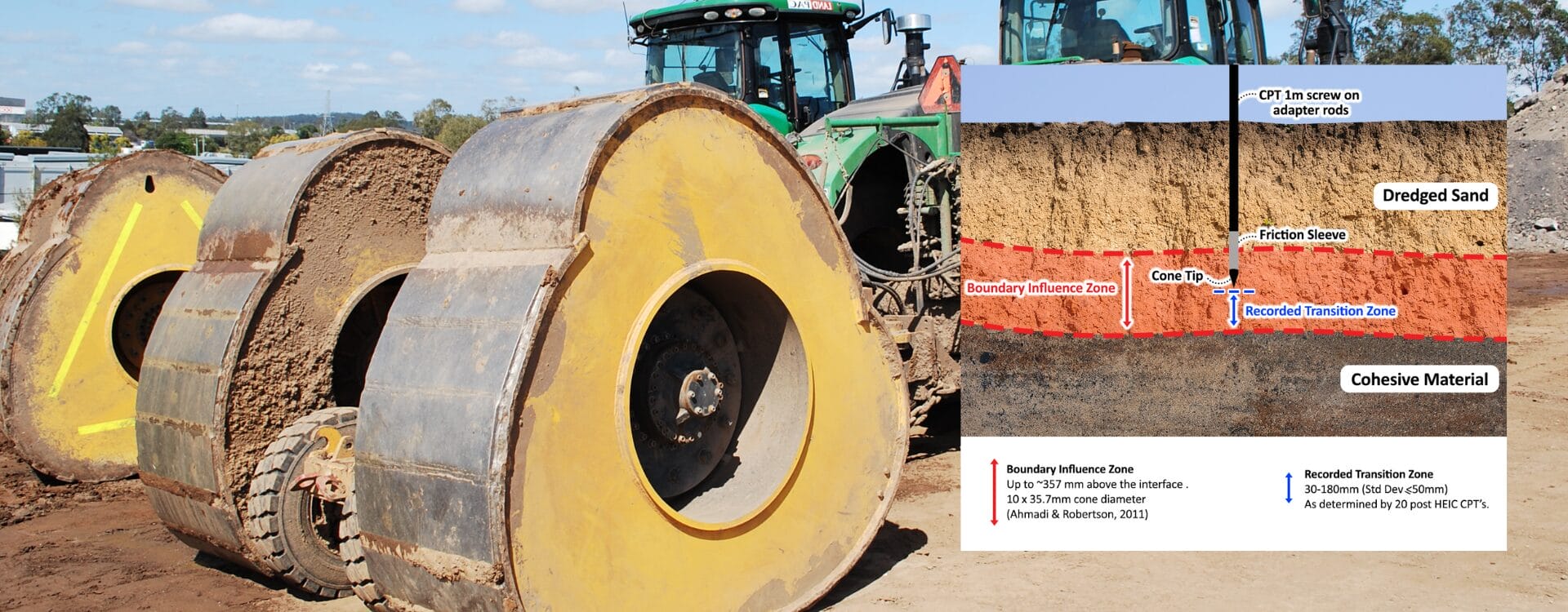
Ahmadi & Robertson (2005) demonstrated that when a CPT cone approaches a significantly softer underlying layer, the measured cone resistance can begin decreasing before the cone physically enters the weaker material. Their work suggests this influence may extend approximately 10 cone diameters above the interface.
For a standard 35.7 mm CPT cone, this corresponds to an influence zone approaching 350 mm.
Physically, this occurs because the cone tip begins sensing the reduced stiffness ahead of the advancing probe. The recorded qc response therefore, reflects not only the material immediately surrounding the cone, but also the changing stiffness conditions below it.
This distinction is important because the measured reduction in qc may not represent inadequate compaction within the overlying sands at all. Instead, it may reflect the mechanical influence of the softer underlying cohesive layer.
In layered systems with strong stiffness contrasts, the CPT response near the interface becomes a transitional response rather than a purely local measurement.
Why qc and fs Do Not Respond Simultaneously
The interpretation becomes more complex when examining the relationship between cone resistance (qc) and sleeve friction (fs) through the transition zone.
The cone tip is positioned ahead of the friction sleeve during penetration. As the CPT approaches softer underlying material, the tip begins reacting first while the sleeve remains within the overlying sands.
Because of this offset, qc and fs do not respond simultaneously through the interface.
The cone resistance may begin decreasing while sleeve friction remains elevated within the sand layer. This creates a temporary mismatch in the CPT response where a sand friction value is mathematically divided by a reduced cone resistance already being influenced by the softer material below.
Since friction ratio is calculated as:
Rf = (fs / qc)
The result can be a large but artificial spike in friction ratio through the transition zone.
Importantly, this spike does not necessarily represent an abrupt change in the actual soil behaviour at that location. Instead, it can be a temporary artefact created by the geometric offset between the cone tip and friction sleeve as the probe transitions across the interface.
This lag effect explains why distinct friction ratio spikes are often observed immediately above strong sand-to-clay transitions. Rather than indicating isolated defects or inconsistent compaction within the fill profile, the response may simply reflect predictable CPT mechanics occurring within the interface zone itself.
Understanding this behaviour becomes critical when interpreting layered soil systems, particularly where strong stiffness contrasts exist between adjacent materials.
Why Misinterpretation Occurs
Without considering interface behaviour, transitional CPT responses can easily be misinterpreted.
Lower qc values near the interface may be interpreted as localised weaker compaction zones, inconsistent ground improvement responses or isolated variability within the profile. Elevated friction ratio spikes can similarly be interpreted as abrupt changes in material behaviour or anomalous subsurface conditions.
In reality, however, these responses may simply reflect normal CPT boundary influence effects occurring within a layered system.
This becomes particularly important in dredged sand fill applications over cohesive foundations where stiffness contrasts are significant and transitional effects become more pronounced.
The repeatability of these responses also matters. When similar qc reductions and friction ratio spikes occur repeatedly across multiple CPT locations at consistent elevations relative to the interface, the behaviour becomes increasingly difficult to attribute to isolated ground variability alone.
Instead, the consistency of the response may support interpretation as a systematic interface effect associated with the underlying cohesive layer.
Interpretation, therefore requires more than simply reviewing numerical outputs. Probe geometry, stiffness contrast, interface mechanics and the relationship between qc, fs and friction ratio all need to be considered together when assessing layered ground behaviour.
This becomes particularly important when considering how calibration influences confidence in interpreting CPT and ICM response behaviour across variable ground conditions. Landpac explored this relationship further in the article on HEIC calibration, correlation and ground response.
Observed Behaviour Within Dredged Sand Fill
On recent investigations involving dredged sand fill overlying cohesive material, lower qc values were consistently observed within the predicted CPT boundary influence zone described by Ahmadi & Robertson (2005).
Importantly, these responses occurred repeatedly across multiple CPT locations and remained within the approximate transition threshold predicted by theory.
The consistency of the response across multiple CPT locations became significant.
Rather than indicating isolated zones of weaker compaction or random variability within the fill profile, the repeatability of the behaviour supported interpretation as a systematic boundary influence effect associated with the underlying cohesive material.
The accompanying relationship between qc reduction, fs lag behaviour and temporary friction ratio increase further reinforced interpretation as a transitional interface response rather than localised ground variability.
Viewed in isolation, these CPT responses may initially appear problematic. Viewed within the context of layered soil mechanics and probe geometry, however, the behaviour becomes both explainable and predictable.
Interpretation Requires Context
CPT data is often presented numerically, but the interpretation of layered soil systems is not purely numerical.
Measured responses need to be considered within the context of soil behaviour, probe geometry and interface mechanics. Transitional effects near material boundaries can produce responses that appear problematic when viewed in isolation despite representing predictable geotechnical behaviour.
Understanding how qc, fs and friction ratio respond through these transitions helps reduce the risk of misinterpreting normal interface behaviour as poor compaction, inconsistent treatment response or anomalous ground conditions.
In layered systems, interpretation matters as much as measurement itself.
Reference
Ahmadi, M.M. & Robertson, P.K. (2005). Thin-layer effects on the CPT qc measurement. Canadian Geotechnical Journal, 42(5), 1302–1317.
Latest news
Interpreting qc Response Near Sand-to-Clay Interfaces
Why lower qc values near sand-to-clay interfaces do not always indicate weaker ground conditions.
High-Energy Impact Compaction: Calibration, Correlation and Ground Response
HEIC does not measure modulus or bearing capacity directly. It measures how the ground responds to impact. This article explains how calibration and correlation transform that response into meaningful, site-specific engineering insight.
Why Modulus Matters: Moving Beyond Density in Ground Improvement
Density has long guided compaction, but it does not reflect how ground performs under load. This article explores the shift to modulus-based verification using HEIC, ICM and in-situ testing.
